


BADASS OF FEBRUARY: ALEXANDER THE GREAT
- Brad Sherwood

- Feb 1, 2024
- 2 min read
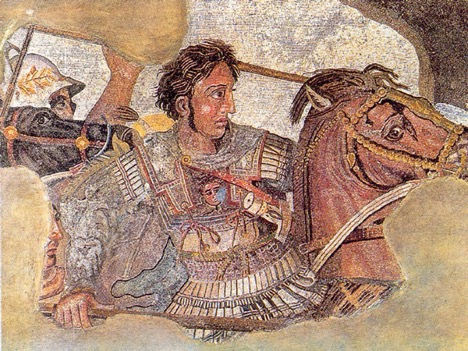
One of the most well-known military leaders in history, Alexander the Great, was born in Pella, Macedonia, in 356 BC. His unmatched military prowess and daring nature forged an empire spanning from Greece to Egypt and well into Asia.
Alexander, who was trained by Aristotle and became interested in philosophy, the arts, and science, was the son of King Philip II of Macedon. Still, his military battles really showed his extraordinary skills. Following the killing of his father, he ascended to the throne at 20, immediately starting an extensive conquest campaign.
Among his most noteworthy military exploits were the victorious Battle of Issus against the Persian Empire, the unwavering siege of Tyre, and the conquest of Egypt, where he was greeted as a liberator. He established Alexandria in Egypt, which grew to be a hub of Hellenistic culture and the location of the renowned Library of Alexandria, the largest collection of knowledge in antiquity.
Just as colorful as Alexander's military expeditions was his private life. Known for leading from the front, inspiring devotion in his soldiers, and possessing charm, he was well-liked as a commander. His fame was further enhanced by his bravery in combat. In addition, he was well renowned for his respect for the traditions of the countries he invaded, frequently assimilating into the local way of life and pushing his warriors to wed native women.
Alexander died at 32 in Babylon in 323 BC, but his legacy lived on in the Hellenistic kingdoms his generals created when they split his empire. His wide dominion allowed him to mingle and transmit ideas, leaving a lasting impact on Greek and Asian culture.
One of the biggest mysteries in history is still where Alexander's last resting place is. His body was sent to Memphis, Egypt, after his passing and then to Alexandria. His tomb's precise site has been forgotten throughout the ages, and while several historians and archaeologists have put forth many suggestions, none of them have been able to provide concrete evidence of where he is ultimately buried.
Alexander has many legacies, but one of his greatest was his emphasis on both education and military prowess. Like Marcus Aurelius, the Roman Emperor who was born 444 years after Alexander’s death, He saw his education as a springboard for his success, and he valued learning, particularly through writing, as vital to society.


Comments